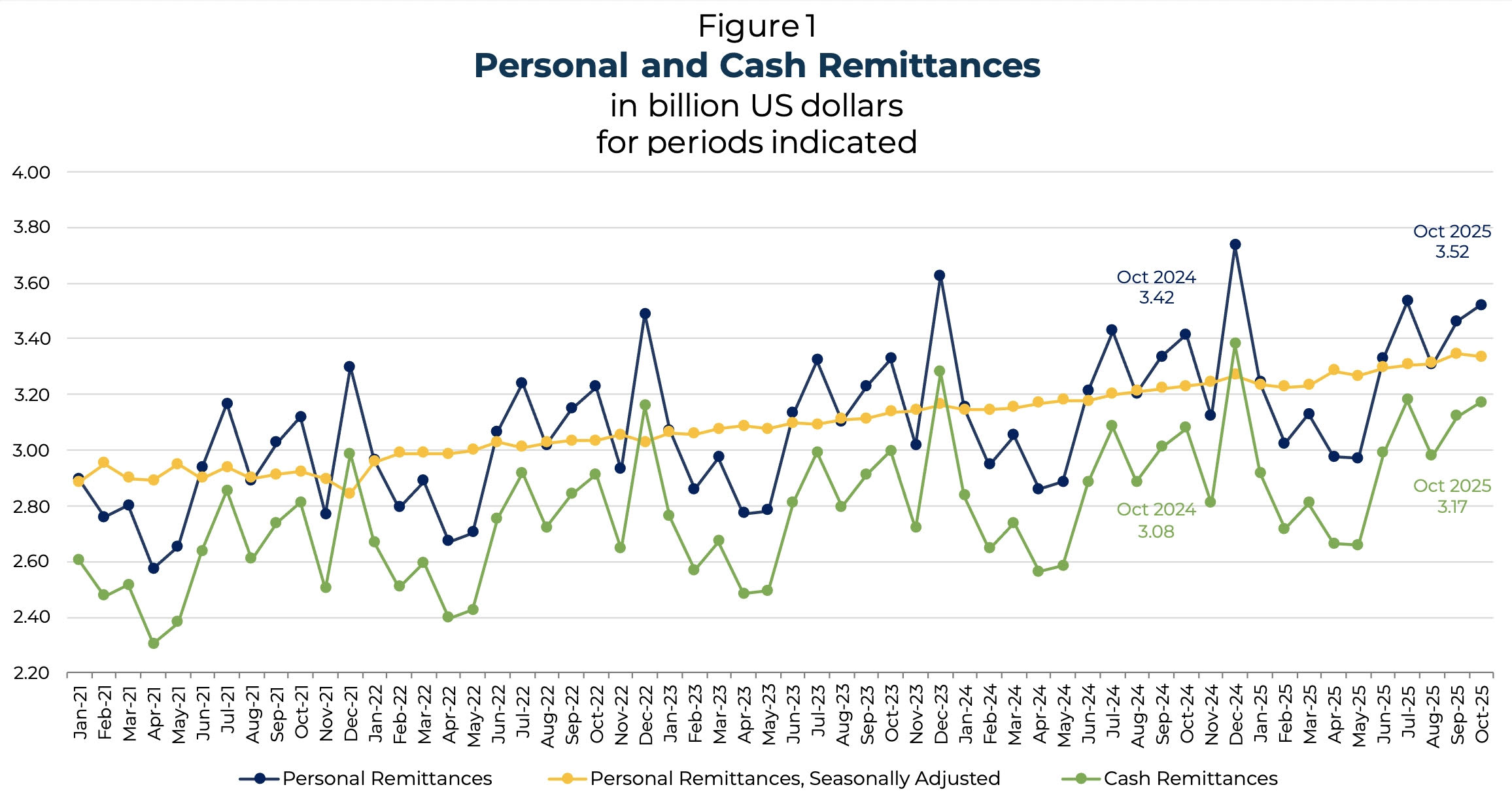

Cash remittances from overseas Filipinos continued to show resilience in October 2025, rising to $3.17 billion and pushing total inflows for the first ten months of the year to $29.20 billion, according to the latest data.
The steady stream of funds underscores the critical role of overseas Filipino workers in supporting household consumption and shoring up the country’s external position.
The United States remained the Philippines’ largest source of remittances during the January to October period, reflecting the size and earning capacity of the Filipino diaspora there. Singapore and Saudi Arabia followed as the next biggest contributors, highlighting the continued importance of both advanced economies and traditional Middle East labor markets to remittance flows.
On a broader measure, personal remittances—which include cash sent through banks and informal channels as well as remittances in kind—reached $3.52 billion in October. Cumulative personal remittances for the first ten months of 2025 amounted to $32.49 billion, reinforcing their status as one of the country’s most stable foreign exchange earners.
Economists have long pointed to remittances as a key buffer against global volatility, providing steady support to domestic demand, particularly for food, housing, education, and healthcare.
The sustained growth in inflows so far this year offers a measure of reassurance amid lingering global economic uncertainty, even as exchange rate movements and host-country labor conditions continue to shape remittance trends.
With the final stretch of the year typically marked by higher holiday-related transfers, analysts expect remittances to remain robust, helping anchor consumption and contribute to overall economic stability as the Philippines heads into 2026.