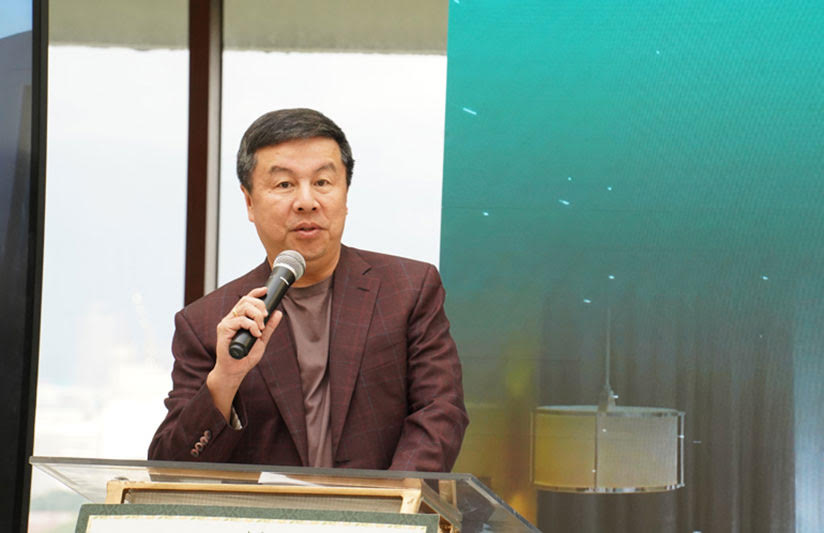

Tech magnate Dennis Uy.
Noting the anger felt by taxpayers over the scandalous rape of public coffers by corrupt government officials, businessman Dennis Anthony Uy has suggested a formula that could somehow assuage the ire of majority of Filipinos.
The technology tycoon cited the slim chances of government’s efforts of recovering hundreds of billions in squandered funds and he is now urging President Ferdinand ‘Bongbong’ Marcos Jr. to seriously consider the idea of abolishing the 12 percent value-added tax (VAT) on utility services.
According to Uy, co-founder and chief-executive-officer of Converge ICT Solutions, the idea of scrapping VAT would serve as moral reparation over the massive corruption mess that corrupted government’s flood control projects.
“Funds intended to address the perennial flooding problem in the country somehow found its way into the pockets of Cabinet secretaries, senators, congressmen, officials of the Department of Public Works and Highways (DPWH), contractors and even (our) state auditors who are supposed to ensure fraud-free government transactions,” he pointed out.
So, as far as the technology magnate is concerned, recovering what has been lost to the massive corruption in the government is easier said than done.
“Wala nang paraan para mabawi lahat ng ninakaw, kahit ibenta pa ang cash, jet, kotse, mansyon at alahas ng mga sangkot,” Uy enthused in reference to what looks more like an orchestrated plan to siphon limited government resources.
“Ang kaya nating gawin ngayon ay ibalik sa tao ang pera sa pamamagitan ng pag alis ng VAT sa kuryente at internet. Ibalik ang perang ninakaw,” he added.
As board member of the Philippine Chamber of Commerce and Industry and of the Private Sector Advisory Council for digital infrastructure, Uy stressed that the government has a moral obligation to give something back to taxpayers who have been at the receiving end of corruption.
“The Philippines is an outlier in Southeast Asia because consumers are charged VAT on electricity from generation, to transmission, to distribution, a layering that pushes the tax load on power close to the equivalent of 36 percentif each stage carries the full 12 percent,” he described the situation.
“Pati nga ‘yung system loss ng power companies, tayo pa ang nagbabayad ng Vat. Ito ang isang paraan para itama ang iskandalo . . . ibalik sa tao ang taxes na ninakaw sa bayan,” he pictured further.
He also emphasized that VAT exemption should not be just for power utilities but also for telecom operators, arguing that internet access has become a basic necessity and to water utilities, although Manila Water and Maynilad are already exempt from the 12 percent VAT under their legislative franchises and instead pay a 2 percent national franchise tax.
According to Uy, sparing the Filipinos from VAT would allow taxpayers to expand the power of the purse from the “loose coins” which when saved would spell a difference.
Such a move, he opined, would also make the government look good as halting the imposition of VAT on essential services would free up cash for households and businesses, support consumption and ease pressure on small and medium enterprises while helping keep prices in check.
“Now is the best time to cut VAT, as public anger over the unprecedented plunder of government funds is peaking and voters are demanding visible justice rather than long investigations that may never fully recover the money,” he claimed.