
The Bureau of Customs (BOC) has streamlined its cargo assessment procedures by removing mandatory prior clearance from the Imports Assessment Service (IAS) for shipments flagged solely on the basis of commodity classification or tariff heading.
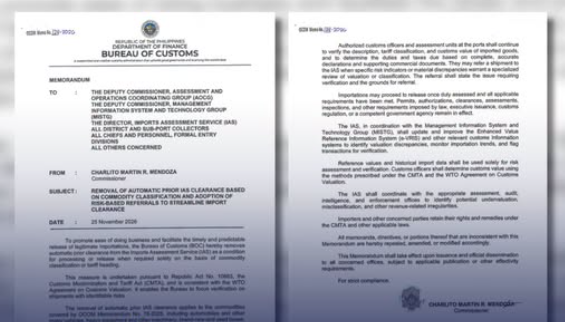
Customs Commissioner Charlito Martin Mendoza issued OCOM Memorandum Order No. 124-2026 on November 25, 2026, introducing reforms aimed at accelerating cargo processing, reducing logistics costs and improving the ease of doing business in the Philippines.
“Our goal is to bring down the cost of doing business in the country. For importers, this reform could reduce cargo processing time by around 3-5 days. That means faster movement of goods and lower logistics costs,” Mendoza said.
The order covers commodities previously subject to mandatory IAS clearance under OCOM Memorandum No. 70-2025, including automobiles, heavy equipment, machinery, buses, trucks, commercial vehicles, ships, boats, iron and steel products, bulk rice and resin.
It also applies to commodities covered by Executive Order No. 877-A, series of 2010, and similar internal customs directives.
Mendoza said the reform reflects the bureau’s transition toward a more risk-based approach to customs assessment, allowing authorities to facilitate legitimate trade while concentrating enforcement resources on potentially irregular shipments.
“We continue to move toward a more risk-based approach to customs assessment. We want our officers to facilitate the release of legitimate shipments and focus their resources on importations that warrant closer scrutiny,” he added.
Under the new guidelines, customs officers at ports will continue to verify product descriptions, tariff classifications and customs values, as well as determine the applicable duties and taxes.
Shipments will only be referred to the IAS when specific risk indicators or material discrepancies require specialized review. Customs personnel must also document the grounds for each referral.
Cargo may proceed to release once assessment procedures are completed and all applicable regulatory requirements are satisfied. Legally mandated permits, clearances and inspections will remain in effect.
The memorandum also directs the IAS and the Management Information System and Technology Group (MISTG) to enhance the Enhanced Value Reference Information System (e-VRIS) and other customs information systems to improve the detection of valuation discrepancies, monitor importation trends and identify transactions requiring further verification.
“The order clarifies that reference values and historical importation data will be used solely for risk assessment and verification, and not as substitute or minimum customs values,” Mendoza said.
Customs valuation will continue to follow the provisions of Republic Act No. 10863, or the Customs Modernization and Tariff Act, and the World Trade Organization Agreement on Customs Valuation.
The IAS will also strengthen coordination with the bureau’s assessment, audit, intelligence and enforcement offices to detect potential undervaluation, misclassification and other revenue-related irregularities.
Transactions requiring further examination after cargo release may be subjected to post-clearance audits, reassessment, collection of deficiencies or appropriate enforcement action.
Mendoza said the reforms were consistent with the directive of President Ferdinand Marcos Jr. and Finance Secretary Frederick Go to simplify government processes and improve the country’s business environment.
“At the BOC, we will do our part. We will continue to review our processes, remove requirements that no longer serve their purpose, and make improvements that our stakeholders can actually feel,” Mendoza said.