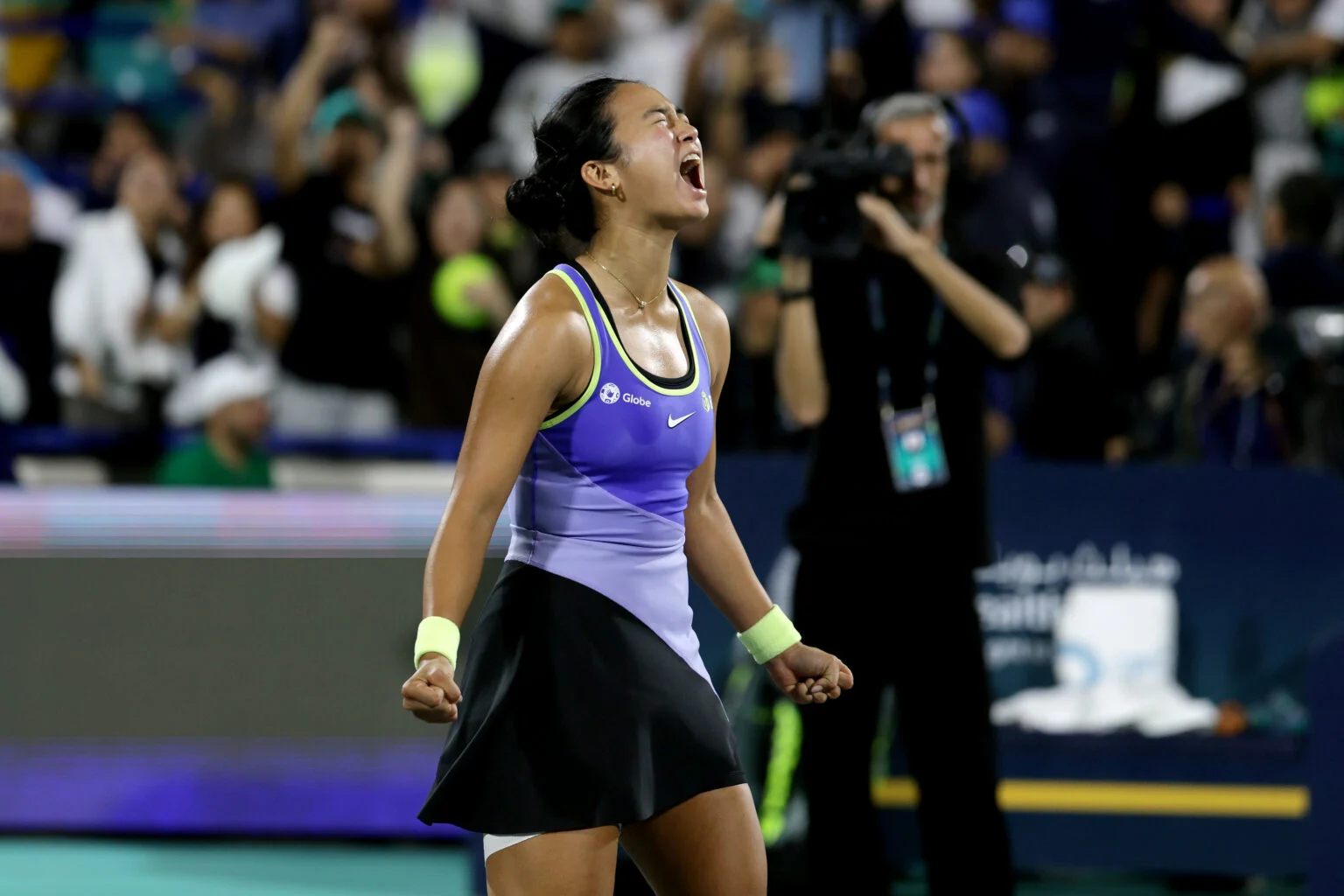

Alexandra “Alex” Eala’s 2026 season continues to read like a breakthrough in progress — deep tournament runs, marquee wins, and an ever-growing global following. Yet as her quarterfinal exit at the Abu Dhabi Open showed, the next phase of her ascent may depend less on talent and more on restraint.
Eala’s loss to world No. 11 Ekaterina Alexandrova in Abu Dhabi ended another encouraging singles campaign, one that included gritty victories over Zeynep Sonmez and Aliaksandra Sasnovich. It was the kind of run that confirms she belongs in the conversation with higher-ranked players.
But the bigger story unfolded off the singles scoreboard: just hours after that defeat, Eala was back on court, this time in doubles, grinding through another high-level match.
That relentless schedule is becoming a familiar pattern.
Since breaking through on the WTA Tour, Eala has rarely limited herself to one discipline. In just the opening stretch of 2026, she has played doubles with Iva Jovic in Auckland, Ingrid Martins at the Australian Open, and Janice Tjen in Abu Dhabi, on top of a full singles slate.
Add upcoming commitments in Doha and Indian Wells, and the calendar leaves little room for recovery — physical or mental — for a 20-year-old still adjusting to the grind of a full WTA season.
Doubles has undeniably sharpened parts of Eala’s game. Her net instincts are better, her hands quicker, and her court awareness more mature than many players her age.
But the modern WTA rankings system is unforgiving: singles results drive status, seeding, and long-term trajectory. Every additional doubles match carries an opportunity cost — energy spent, recovery shortened, focus divided.
At the top of the women’s game, few players manage to balance both consistently. Even among the elite, sustained singles success usually comes with a deliberate narrowing of priorities.
Jasmine Paolini is often cited as an exception, but her doubles success is built around a stable, long-term partnership and carefully managed scheduling. For most others eyeing the top 20, doubles becomes selective rather than routine.
For Eala, the risk is not immediate collapse, but gradual erosion. The signs are subtle: heavy legs late in matches, reduced explosiveness against power hitters, and the mental fatigue that comes from never truly switching off.
Abu Dhabi hinted at that danger — a strong effort, but one where Alexandrova’s sustained pace eventually told.
If Eala wants to keep climbing, the adjustment does not require abandoning doubles altogether. The change is more strategic than dramatic: choosing fewer events, committing to doubles only when it serves a clear developmental or tactical purpose, and protecting her body during congested stretches of the calendar.
As her ranking rises, so will expectations — and the margins for error.
There are also technical steps that remain central to her growth. Against the tour’s hardest hitters, Eala still needs more free points on serve and greater variety when rallies turn into power exchanges.
Those improvements demand focused training blocks, not constant match play across formats.
None of this diminishes what Eala has already achieved. She remains one of the most compelling young players on the tour — poised, intelligent, and unafraid of the big stage. Filipino fans have every reason to be proud of how far she has come, and optimistic about how high she can go.
But the next leap — from promising contender to consistent threat — may hinge on one difficult lesson every elite athlete must learn: sometimes, doing less is the only way to achieve more.