
By Gladys Serafica
DARAGA, Albay – As Filipino comedian and singer Gil Aducal Morales, widely known as Ate Gay, is laid to rest, his death reminds us that perhaps the most heartfelt goodbyes need not be reserved for eulogies delivered in the aftermath of loss.
By choosing to hold a “living funeral” on Oct. 15, barely three weeks before he drew his last breath on Nov. 1, he gave life to conversations long buried by Philippine society’s cultural taboos surrounding mortality.
In simple terms, a living funeral, also called a pre-funeral or living wake, is a celebration organized to honor someone who is still alive.
While embraced in other countries, such as Japan and South Korea, psychologist Salvacion Villafuerte said it is not a widely established or traditional practice in the country. This is because some families may find it uncomfortable, as talking openly about death is still considered sensitive, frightening or even inappropriate.
In Albay province, for example, a living wake may be construed by others as “palugsuk,” akin to bringing bad luck or inviting misfortune.
But while a living wake is not a mainstream cultural practice in the country, “the values underlying them are not necessarily foreign to Filipino culture.”
“Filipinos place great importance on family, relationships, remembrance, and honoring loved ones. Traditionally, we express these through wakes, prayers, and gatherings after someone has died,” the former chair of the Bicol University (BU) psychology department said.
A living funeral, however, inverts the natural order of things because it gathers the people closest to a person to celebrate their presence instead of the usual way of bringing them together to mourn their absence.
Drawing from the perspective of Sikolohiyang Pilipino, Villafuerte explained that a living funeral may be understood through “kapwa,” or our shared identity and connectedness with others.
“What makes it meaningful is not the funeral itself but the relationships that are affirmed through the experience.”
“In Sikolohiyang Pilipino, our sense of self is closely connected with kapwa. We understand who we are partly through our relationships with family, friends and community,” she said.
According to her, a living funeral may fulfill several psychological needs, particularly the need for connection, appreciation, acceptance and a sense of control over one’s death.
By allowing people to feel valued, remembered and connected, she said perhaps the greatest psychological value of the practice is the opportunity to experience the love and appreciation that are so often expressed only after the person is gone.
Rooted in Filipino values
The decision to hold a living wake, however, would depend on “how the person and the family understand death, their relationships, and their cultural and religious beliefs.”
She added that Filipino values also mediate whether individuals would accept or reject the practice.
“Filipino values such as utang na loob, pakikisama, pagmamahal sa pamilya, and pakikipagkapwa (debt of gratitude, fellowship, love for family and human relations) may influence the decision to hold a living funeral,” she said.
She explained that a person may wish to gather loved ones to express gratitude, acknowledge sacrifices or strengthen family relationships.
Consequently, values associated with hiya, religious beliefs and the desire to protect loved ones from emotional distress may discourage some people from holding such an event.
“Some may feel that organizing a funeral while still alive is inviting death or unnecessarily worrying the family,” she added.
In the perspective of death psychology, however, a pre-funeral can be a means of confronting death anxiety.
“Rather than avoiding thoughts about death, the person chooses to acknowledge mortality and find meaning in the life they have lived,” she said.
Navigating grief
Because a living funeral provides an opportunity to express feelings that are often left unsaid, such as love, gratitude, regret or forgiveness, it can also help individuals come to terms with grief.
Villafuerte, however, cautioned that it does not mean that grief will no longer occur.
“Grief is a natural response to losing someone meaningful to us,” she said.
While a pre-funeral may not guarantee closure, she said it can lessen the burden of unfinished conversations and help prepare people emotionally for an eventual loss.
“Closure does not necessarily mean forgetting, moving on completely, or no longer feeling sadness. We do not simply close a relationship because someone has died,” she added.
Hence, what the experience may provide is a greater sense of peace, acceptance and continuing connection.
For BU Literature teacher Viveth Morcozo, the practice is significant because it can transform grief and anticipated loss into an affirmation of life.
“Why wait until someone is dead to tell them how much they matter? It is much better to hear words of appreciation and experience the love while one is still alive than have them delivered when it is already too late,” she said. (PNA)
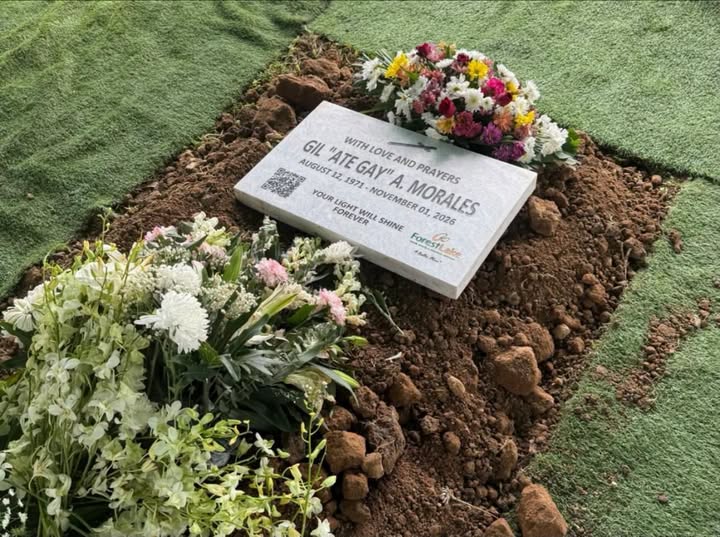
FINAL FAREWELL. The grave of Filipino comedian and singer Gil Aducal Morales, widely known as Ate Gay, at Forest Lake Memorial Park in Biñan, Laguna. Renowned for impersonating the late National Artist Nora Aunor and his iconic mashups, he passed away at age 55 on Nov. 1, 2026 after battling stage 4 cancer. (Photo from Gil Aducal Morales Facebook)