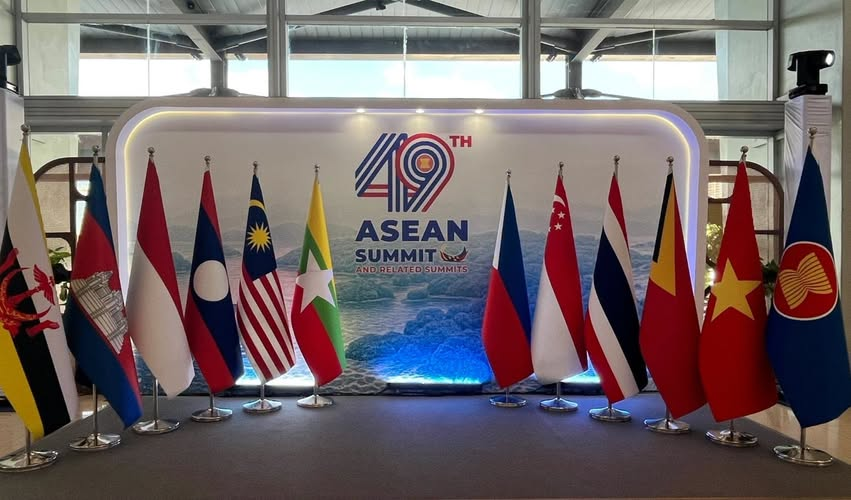
MANILA – The Philippines on Wednesday highlighted its capacity to host large events as it soft-opened the International Media Center (IMC) for foreign and local media covering the upcoming 49th Association of Southeast Asian Nations (ASEAN) Summit and Related Meetings this week.
The IMC inside the World Trade Center in Pasay City houses several briefing rooms, podcast and television studios, as well as media broadcast and audio booths.
The Philippine Pavilion at Hall B features a Filipino beverage/coffee space and a Boracay-inspired health and wellness station that offers traditional “hilot” (massage) to delegates.
An Intramuros-inspired Filipino street setup then connects the main halls of the World Trade Center (WTC) to Hall D, which hosts the One Town, One Product (OTOP) exhibit, featuring local products from across the archipelago, the “Gastronomy Kiosks,” and the Philippine Postal Corp. (PHLPost) snail mail booths.
The “Pinoy Kalye” is among the many features of the IMC to give delegates a taste of Filipino everyday life, allowing them to shop at a “sari-sari store” and enjoy a serving of the classic Filipino street dessert, taho (sweetened silken tofu).
The snail mail and stamp collector booth, on the other hand, lets delegates and foreign/local media buy collectible stamps and send postcards to their home countries.
“The instruction of Secretary Dita Angara-Mathay is for us to showcase the Philippines. What we’re hoping to happen is that our delegates will have a glimpse of the Philippines when they come to the IMC,” Tourism Assistant Secretary Ina Zara-Loyola said in an interview with the Philippine News Agency.
“The intention is for us to allow them to taste the iconic dishes of each of the regions of the country, the provinces,” she added.
Decorated Michelin-recognized chefs Francis Lacson of Marikina-based contemporary Filipino restaurant Digamo and Miguel Cabel Moreno of Palm Grill are curating the gastronomy kiosks, which highlight some of the Philippines’ iconic dishes from Luzon, Visayas and Mindanao.
In an interview, Moreno conveyed hopes that the upcoming international event would show the world that “the Philippines is a place that they should consider to discover and visit.”
Through his curation of Mindanaoan dishes, the Filipino chef said he intends to make foreign visitors feel that the country is “really indeed vibrant.”
“It has a lot of culture and history, and there is a lot of similarities actually with our Southeast Asia neighboring countries as well. And the Mindanao Island is proof of that,” he said in an interview.
“Ang dream ko moving forward is for Filipino cuisine to be at par with our other Southeast Asian and Asian cuisines that are known in the rest of the world. Hopefully, the Philippines is getting there,” he added.
Lacson, for his part, wants foreign visitors to know and “experience” that there is more to Filipino food than what they already know.
“Like the lumpia, the kare-kare, the adobo — there’s more in the regions, there’s more in the provinces. What we’re trying to do here is we’re trying to present it in the most traditional way as it can be, so that people will really experience or appreciate it the way it should be experienced,” he said.
ASEAN National Organizing Council Assistant Director-General Hazel Abad said the IMC soft opening highlights the Philippines’ capacity to host large and international events by delivering quality venues and services.
“Ang hosting natin ay almost one year na (Our hosting is set to mark its full year), this upcoming summit is our culminating event for ASEAN, and we’re happy to say that we are ready to host everyone,” she told the PNA.
“With the IMC opening, we show that hindi lang tayo ready (that we are not only ready) technically or logistically, we are ready for all our media friends, locally and internationally, to experience Philippines hospitality at its best,” she added.
Abad said the IMC will accommodate some 2,000 local and foreign press throughout the ministerial and summit week, taking place from Nov. 13 to 17. (Joyce Rocamora/PNA)