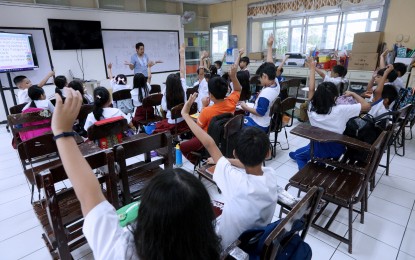
Education Secretary Sonny Angara is shifting the government’s school-building strategy away from a centralized model, tapping local government units (LGUs) and the private sector to lead the construction of nearly 25,000 classrooms this year.
The move marks a significant departure from previous years, where the Department of Public Works and Highways (DPWH) held sole authority over school infrastructure projects.
Speaking at a Malacañang press briefing on Tuesday, Angara confirmed that the Department of Education (DepEd) is leveraging a new “flexibility provision” in the 2026 budget to bypass long-standing construction bottlenecks.
Angara explained that the department is moving away from a paradigm where a single institution handles all projects, noting that LGUs are often better positioned to monitor progress on the ground.
Under this new multi-track approach, over 50 mayors and numerous provinces have already volunteered to manage construction directly using national funds.
This decentralized strategy significantly reduces the load on the DPWH, which is now slated to handle as little as 10% to 25% of the total target, or roughly 2,000 to 6,000 units.
Additionally, the DepEd is re-engaging the private sector through Public-Private Partnerships to build school clusters in bulk and allowing accredited non-governmental organizations to participate in the rollout.
The shift in strategy is backed by a historic P1.015-trillion budget for the DepEd, with P65 billion specifically earmarked for the construction of 24,964 new classrooms and P7.7 billion for repairs.
While the 2026 goal represents a record-breaking rollout, Angara clarified that the timeline refers to the initiation of these projects rather than immediate completion.
Given that large-scale construction typically spans two to three years, the Secretary noted that work on all 24,000 units will begin this year, with completion phased through 2027 and 2028.
Angara acknowledged that while there may be growing pains in implementing such a large-scale change, the goal is to finally break the logjam that has caused a perennial classroom shortage for Filipino students.