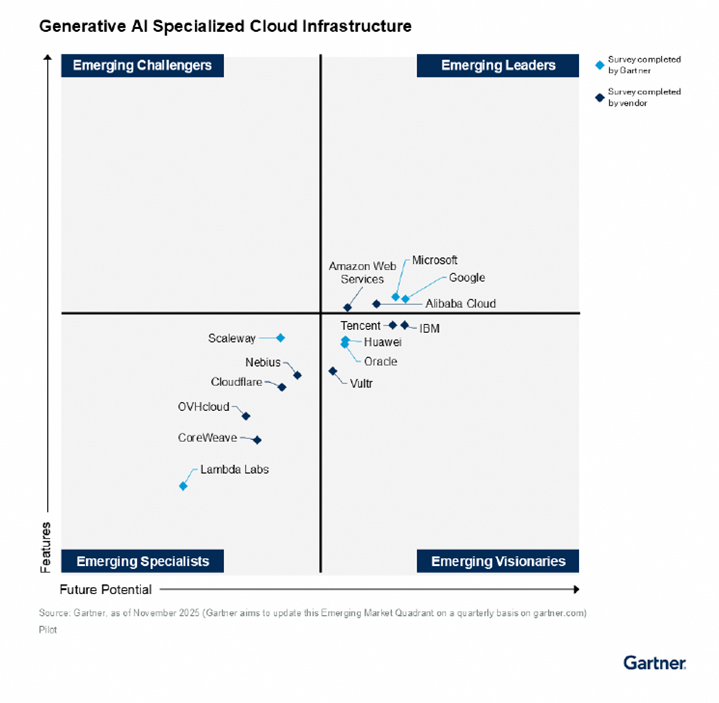

Hangzhou, China — Alibaba Cloud has once again been named an Emerging Leader across all four quadrants evaluated in the latest Gartner “Innovation Guide for Generative AI” reports, reinforcing the company’s position as one of the few providers globally with credible, end-to-end generative AI capabilities.
The recognition, published in November 2025, places Alibaba Cloud in the Emerging Leader category for generative AI specialized cloud infrastructure, generative AI model providers, generative AI engineering, and generative AI knowledge management applications.
According to Gartner, the Emerging Market Quadrant visualizes vendors in a fast-moving and highly dynamic space, with Emerging Leaders distinguished by strong product features, growing market visibility, and clear future potential.
For Alibaba Cloud, the sweep across all four quadrants underscores the maturity of its integrated “AI + Cloud” strategy. Jingren Zhou, Chief Technology Officer of Alibaba Cloud Intelligence, said the recognition validates the company’s long-term approach to building a cohesive generative AI ecosystem rather than isolated tools.
From the infrastructure layer upward, Alibaba Cloud has positioned itself as a key enabler of AI workloads, offering high-performance compute, storage, and networking optimized for large-scale training and inference.
Notably, it is the only cloud service provider in the Asia-Pacific region to be recognized as an Emerging Leader in this category alongside a small group of global peers, highlighting its growing influence beyond its home market.
At the model layer, Alibaba Cloud’s strength is anchored by its proprietary Qwen family of foundation models. The Qwen series, including the latest Qwen3 release, has gained significant traction in the global AI community. Its open-source variants have surpassed 600 million downloads across platforms such as Hugging Face and ModelScope, spawning more than 170,000 derivative models.
This broad adoption has helped position Alibaba not just as a model provider, but as a catalyst for downstream innovation.
That model momentum feeds directly into Alibaba Cloud’s engineering and application stack. Through its Model Studio platform, enterprises and individual developers can fine-tune, manage, and deploy models efficiently, leveraging large language models like Qwen as well as the visual-generation Wan model family.
The platform now serves more than one million corporate and individual users, reflecting accelerating demand for production-ready GenAI tools.
On the engineering side, Alibaba Cloud’s Platform for AI (PAI) supports the full AI lifecycle within a single, integrated environment. From data labeling and model development to training, optimization, and real-world deployment, PAI is designed to reduce friction for enterprises building and scaling generative AI systems, a capability Gartner highlights as increasingly critical as organizations move from experimentation to execution.
The company’s capabilities extend into knowledge management applications, where generative AI is being used to retrieve, contextualize, and operationalize enterprise information. By combining retrieval-augmented generation and agentic AI, Alibaba Cloud enables organizations to transform internal knowledge bases into actionable insights. These technologies are already being applied across industries ranging from autonomous driving and smart healthcare to logistics, consumer electronics, and next-generation e-commerce.
Zhou said Alibaba Cloud’s focus remains on long-term value creation rather than short-term hype, emphasizing that adoption, scalability, and real-world impact will ultimately define success in generative AI. With the pace of innovation accelerating, he added, Alibaba Cloud has deliberately shaped its ecosystem to meet not only today’s requirements but the demands of a rapidly evolving AI landscape.
The latest recognition follows a similar outcome last year, when Alibaba Cloud was also named an Emerging Leader across all four quadrants in the previous Gartner “Innovation Guide for Generative AI Technologies” report, reinforcing a pattern of consistent execution as the global GenAI market continues to take shape.
