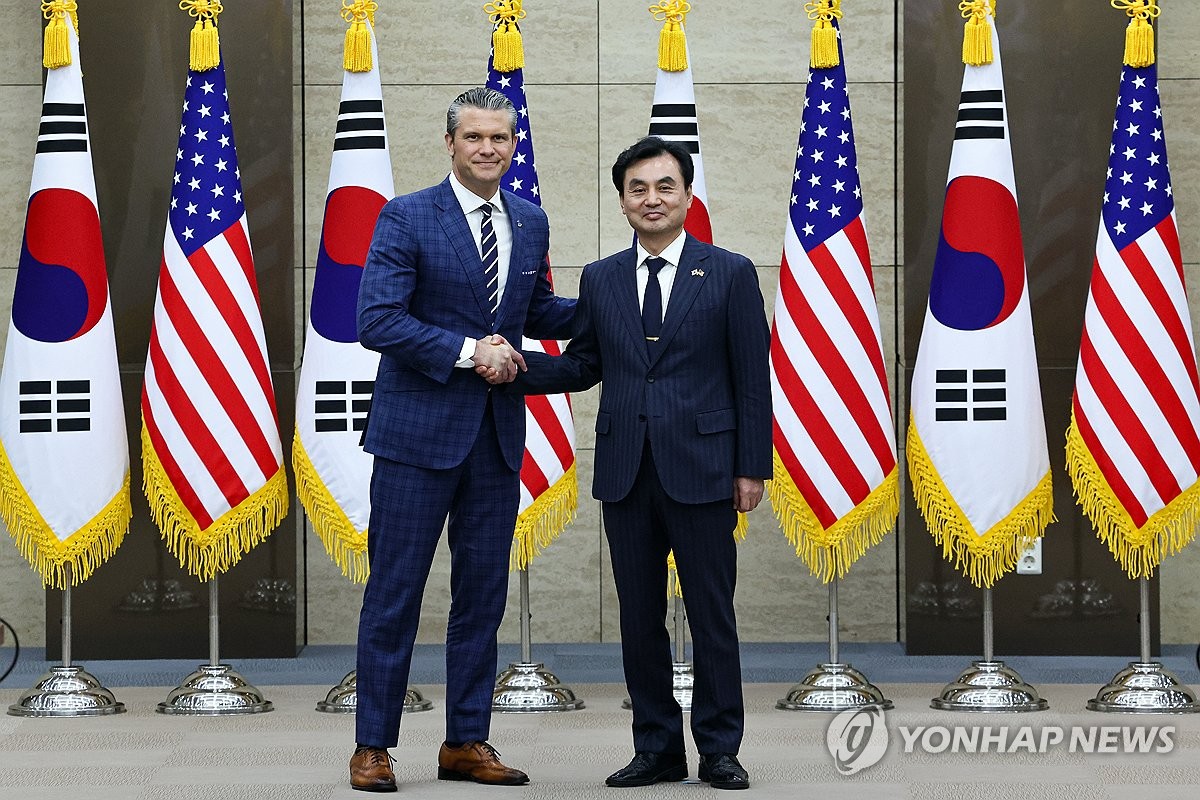
The defense chiefs of South Korea and the United States have agreed to develop a road map designed to “expedite” the implementation of conditions for the transfer of wartime operational control (OPCON), a joint communique showed Friday, as President Lee Jae Myung’s administration pushes to regain it from the U.S. within its term ending in 2030.
Defense Minister Ahn Gyu-back and Defense Secretary Pete Hegseth reached the agreement during the allies’ annual defense talks, called the Security Consultative Meeting (SCM), in Seoul on Nov. 4, according to the document, as Seoul seeks to beef up its independent military capabilities, with the U.S. calling for it to do more for its own defense.
The two sides also agreed to seek the certification of “full operational capability (FOC)” next year — the second part of a three-stage program aimed at vetting Seoul’s capabilities to lead the allies’ combined forces. The program is part of various conditions required for the OPCON handover.
On the 28,500-strong U.S. Forces Korea (USFK), the communique omitted what had largely been a boilerplate phrase underlining Washington’s commitment to maintaining the “current level” of USFK troops, adding to speculation the U.S. may be open to the possibility of a troop drawdown in South Korea.
“The two leaders pledged to develop a roadmap to acquire the capabilities necessary to expedite the implementation of conditions required for wartime OPCON transition, and to pursue the certification of Full Operational Capability of Future-Combined Forces Command Headquarters in 2026,” the communique reads.
Ahn and Hegseth also reaffirmed that the conditions stated in a related bilateral agreement for the OPCON handover must be met before OPCON is transitioned in a “systematic, stable, and proactive” manner. The two sides also assessed that “significant” progress has been made in the OPCON transition efforts.
The conditions include South Korea’s capabilities to lead combined Korea-U.S. forces, its strike and air defense capabilities, and a regional security environment conducive to such a handover.
South Korea handed over operational control of its troops to the U.S.-led U.N. Command during the 1950-53 Korean War. It was then transferred to the two allies’ Combined Forces Command when the command was launched in 1978. Wartime OPCON still remains in U.S. hands, while Korea retook peacetime OPCON in 1994.
The public has been divided over the high-stakes issue. Opponents have raised concerns that the OPCON transfer could lead to a weakening of America’s security commitment, while supporters argue the transfer would bolster efforts to enhance South Korea’s independent military capabilities and greater autonomy in the alliance.
The communique specified South Korea’s plan to increase defense spending to 3.5 percent of its gross domestic product “as soon as possible” in accordance with South Korea’s legal requirements — as also indicated in a joint fact sheet detailing discussions of summits talks between Lee and U.S. President Donald Trump on Oct. 29.
“We emphasized our determination to continuously strengthen defense capabilities so that South Korea can play a leading role in defending the security of the Korean Peninsula based on a powerful combined defense posture,” Ahn said in a press briefing Friday, as he explained the defense spending hike plan.
During the SCM, Hegseth announced that a U.S. warship would undergo maintenance, repair and overhaul (MRO) in South Korea for the first time in what the document called “historic progress” to enhance U.S. readiness and deterrence. The MRO plan comes as Seoul and Washington seek to strengthen cooperation in rebuilding America’s shipbuilding industry.
Hegseth also noted that the U.S. remains committed to the four pillars of the Singapore summit between U.S. President Donald Trump and North Korean leader Kim Jong-un in 2018.
The pillars include the transformation of bilateral ties, a “lasting and stable” peace regime on the Korean Peninsula, denuclearization, and recovery of the remains of prisoners of war and those who went missing during the 1950-53 Korean War.
In addition, the two sides pledged to continue the work of the Nuclear Consultative Group (NCG), the allies’ key nuclear deterrence body.
The NCG was launched in July 2023 to strengthen the credibility of America’s extended deterrence commitment to using the full range of its military capabilities to defend its ally and reaffirm South Korea’s commitment to non-proliferation. Its last and fourth session took place in Washington in January.
The joint communique did not include a stern warning against a potential North Korean nuclear attack, whereas last year’s statement entailed a warning that any nuclear attack by the North against the U.S. and its allies would result in the end of the Kim regime.
Both sides emphasized the importance of maintaining peace and stability across the Taiwan Strait and shared views on the need for a “peaceful” resolution of cross-strait issues, according to the statement.
This year’s SCM came as the allies seek to “modernize” their alliance amid a changing security environment and threats, marked by an increasingly assertive China, North Korea’s advancing nuclear and missile threats as well as an intensifying global arms race.
Details of the SCM communique were also outlined in the joint fact sheet released earlier in the day, including a reaffirmation of the U.S. commitment to the defense of South Korea through the “enduring presence” of the USFK and extended deterrence.
In the fact sheet, South Korea pledged to spend US$25 billion on U.S. military equipment purchases by 2030 and provide “comprehensive” support for the USFK estimated at $33 billion in accordance with South Korea’s legal requirements.
The leaders of the two countries also vowed commitment to cooperation for the transition of OPCON from Washington to Seoul and said the allies will enhance U.S. conventional deterrence posture against “all” regional threats, including North Korea, in what was seen as underscoring a U.S call for Seoul to contribute to deterring Chinese threats.
South Korea’s push for a nuclear-powered submarine and formal U.S. approval for the plan, indicated in the joint fact sheet, was not included in the joint communique.
But Ahn said in the briefing the defense chiefs agreed to actively push to cooperate on building the nuclear-powered submarine as discussed in summit talks between their leaders.