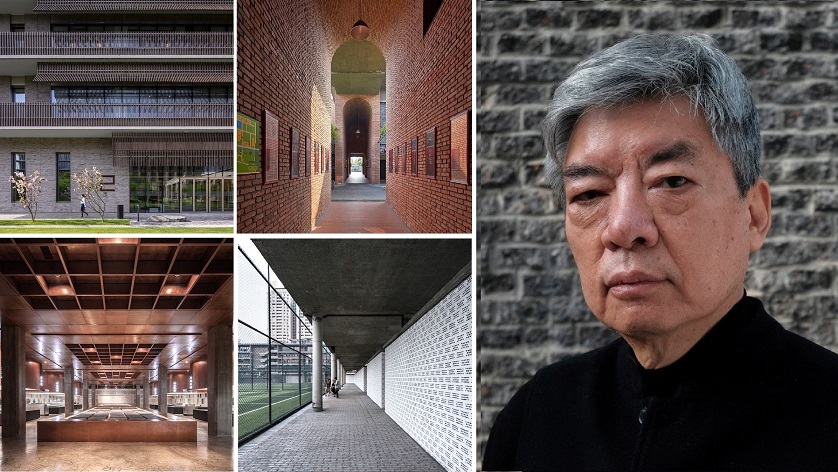
Chinese architect Liu Jiakun, founder of Jiakun Architects, has been named the 2025 Laureate of the Pritzker Architecture Prize, the highest honor in the field and often referred to as the “Nobel Prize of architecture.”
His work focuses on creating architecture that transcends aesthetics, blending history, culture, and modernity while celebrating the lives of ordinary people. His designs seek to evoke emotions such as compassion and serenity, shaping environments that foster a sense of community.
“Architecture should reveal something—it should abstract, distill, and make visible the inherent qualities of local people,” Liu said.
Over his four-decade career, Liu has avoided adhering to a single style, instead developing a flexible approach that tailors each project to its specific context. His designs often blend different typologies and emphasize the integration of civic spaces with the needs of modern urban life. Notable examples include West Village (Chengdu, 2015), a five-story development that creates a vibrant, open public space within the dense urban fabric. The Sichuan Fine Arts Institute Department of Sculpture (Chongqing, 2004) showcases his ability to adapt limited space, extending upper levels outward to create more room in a narrow footprint.
Pritzker Prize jury chair Alejandro Aravena praised Liu for creating spaces that blend architecture, infrastructure, landscape, and public areas. “Cities tend to segregate functions but Liu Jiakun takes the opposite approach and sustains a delicate balance to integrate all dimensions of the urban life. In a world that tends to create endless dull peripheries, he has found a way to build places that… confront the challenges of urbanization in an era of rapidly growing cities.”
Liu’s designs also reflect a deep reverence for cultural and natural heritage. His works often reinterpret traditional Chinese architectural forms, such as the tiered balconies of Novartis (Shanghai, 2014), inspired by ancient tower designs, or the Suzhou Museum of Imperial Kiln Brick (Suzhou, 2016), with its flat eaves reminiscent of centuries-old pavilions. In the Luyeyuan Stone Sculpture Art Museum (Chengdu, 2002), Liu balances the natural landscape with built elements, reflecting a harmonious relationship between architecture and nature.
One of Liu’s core principles is his use of local, sustainable materials that honor both the environment and the communities he serves. He often incorporates raw, traditional craftsmanship into his buildings, as seen in the swirling details of Chongqing sand plastering at the Department of Sculpture. After the 2008 Wenchuan earthquake, Liu revived rubble to create “Rebirth Bricks,” combining local wheat fiber and cement to produce more durable, cost-effective materials. These bricks can be found in several projects, including the Shuijingfang Museum (Chengdu, 2013) and West Village.
“Liu Jiakun uplifts through the process and purpose of architecture,” said Tom Pritzker, chairman of The Hyatt Foundation, which sponsors the award. “There is a wisdom in his architecture, philosophically looking beyond the surface to reveal that history, materials, and nature are symbiotic.”
Throughout his career, Liu has designed more than 30 projects across China, including significant works like the Museum of Clocks (Jianchuan Museum Cluster, 2007), Songyang Culture Neighborhood (Lishui, 2020), and the Chengdu High-Tech Zone Tianfu Software Park Communication Center (Chengdu, 2010).
Born in Chengdu, China, Liu, the 54th Pritzker Laureate, will be honored in Abu Dhabi this spring. A virtual ceremony and public lecture will follow in the fall, according to the Pritzker Architecture Prize. The 2025 Laureate Lecture and Panel Discussion will take place in May and will be open to the public both in-person and online.