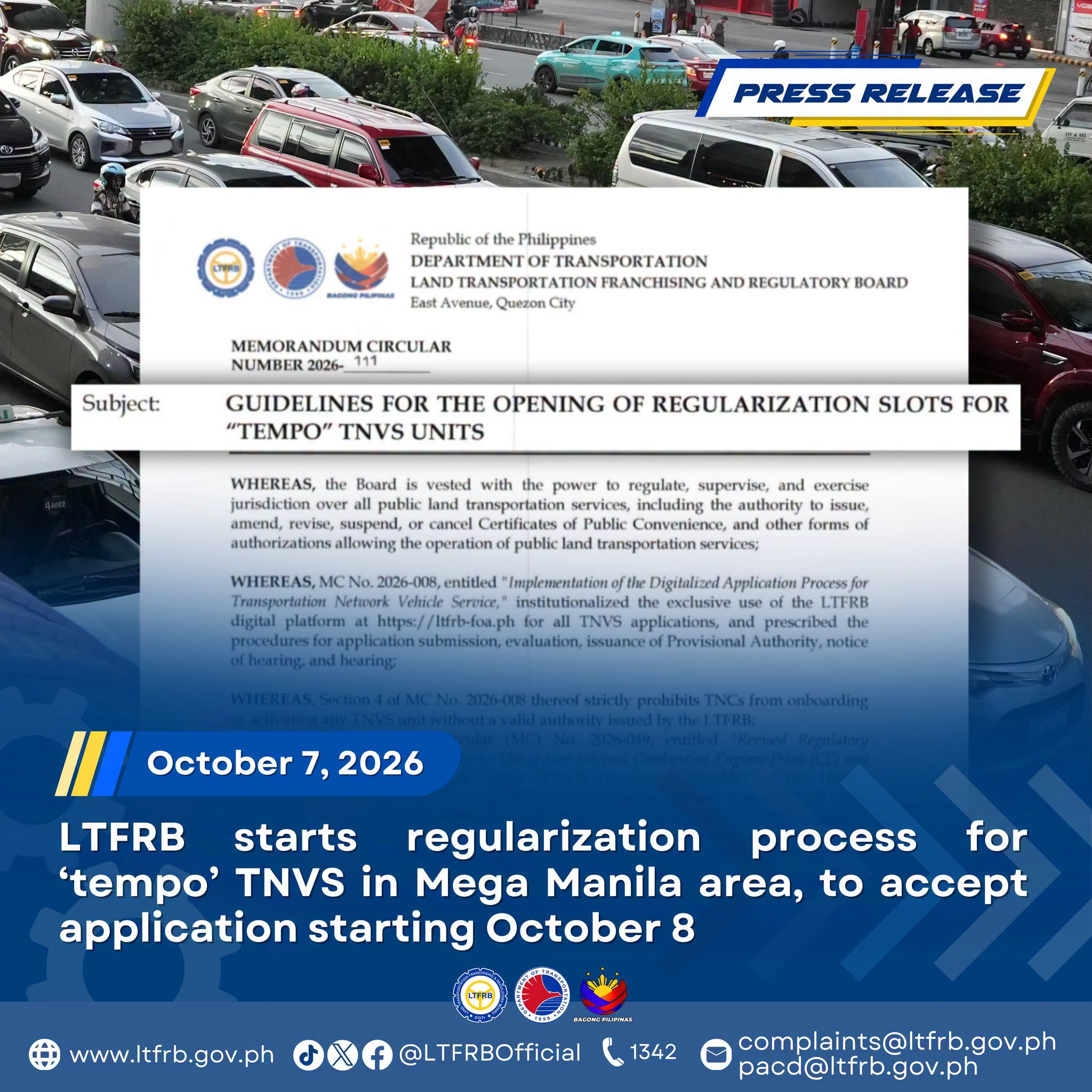

The Land Transportation Franchising and Regulatory Board (LTFRB), in compliance with the order of Department of Transportation (DOTr) Secretary Giovanni Z. “Banoy” Lopez, has issued a policy that will govern the regularization of Transport Network Vehicle Service (TNVS) operating in Metro Manila under the so-called “tempo”. “Tempo” is known in the transport community, especially in TNVS, as a practice of the Transport Network Companies (TNCs) of onboarding TNVS units on their digital platforms without the units having obtained the requisite authority from the LTFRB. The practice violates the rules and regulations of the LTFRB as it provides access to TNVS units to offer transport services to the riding public despite the absence of a valid authority. Acting LTFRB Chairman Atty. Greg G. Pua, Jr. said opening for application will start on October 8 and will run for 30 calendar days, as he stressed that all submissions will be processed exclusively online through the official LTFRB digital platform (https ://ltfrb-foa. ph) or any other digital portal designated by the agency. He, however, said that applications may be filed directly by individual TNVS operators or by accredited TNCs through their authorized representatives on behalf of eligible drivers. Acting Chairman Pua said the latest action of the LTFRB through Memorandum Circular 2026-111, under the guidance of Secretary Banoy, is intended to help thousands of TNVS drivers whose only fault was that they relied in good faith on their onboarding and assumed substantial financial commitments in the process. “It is the policy of both the DOTr and the LTFRB that no driver or operator be left behind by a regulatory intervention occasioned by the fault of another, and denying them an opportunity to regularize would cause undue hardship and disrupt the continuity of adequate transport services,” Acting Chairman Pua said, citing the memorandum circular. He said such a move is in line with the instruction of President Ferdinand “Bongbong R. Marcos, Jr. to implement fair rules and regulations to ensure that the welfare of the public transport sector is also attended. Acting Chairman Pua also emphasized that that the policy applies strictly to unauthorized units listed in the validated masterlists previously submitted by TNCs. He clarified that the memorandum circular does not represent a general opening for new TNVS applications across the board, nor does it waive any administrative liabilities incurred by TNCs for onboarding unauthorized vehicles. Acting Chairman Pua said the policy covers MUCEP (Metro Manila Urban Transportation Integration Study Update and Capacity Enhancement Program) area, adding that applications submitted beyond the deadline will not be accepted. Under the guidelines, the total number of regularization slots will match the number of unauthorized TNVS units identified in the validated masterlists and official board records. To qualify for the regularization program, vehicles must meet specific conditions on the matters concerning roadworthiness. The rules stated that only motor vehicles whose plate numbers appear on the validated masterlist submitted for investigation are eligible to apply. Vehicles must undergo and pass a roadworthiness test at an LTFRB-recognized Private Motor Vehicle Inspection Center (PMVIC). Proof of inspection must be transmitted electronically from the PMVIC directly to the LTFRB system before a Provisional Authority (PA) can be issued. In addition, vehicles exceeding the standard seven-year age limit are ineligible. However, overage units may be dropped and replaced with a qualified substitute vehicle in accordance with existing LTFRB rules before receiving authority. To streamline the process, Acting Chairman Pua said applicants are no longer required to manually upload their Personal Passenger Accident Insurance (PPAI) policies. Insurance coverage must instead be acquired directly from an accredited provider integrated into the LTFRB system, allowing policy details to automatically reflect in the applicant’s online portal. Furthermore, the agency confirmed that certain previous restrictions—specifically the three-year vehicle model limitation and the five-vehicle cap per applicant outlined in MC No. 2026-008—will not apply to applications filed under this memorandum circular. #