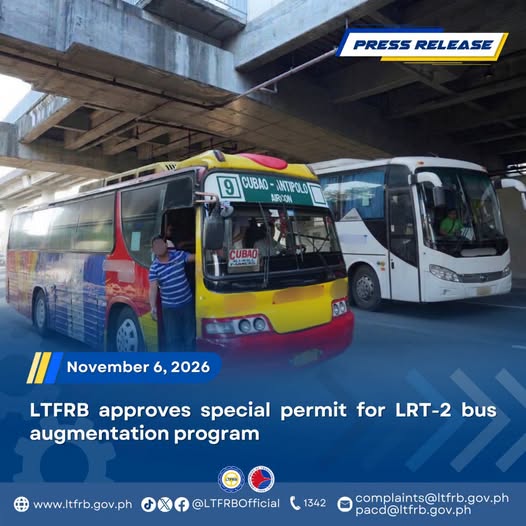

The Land Transportation Franchising and Regulatory Board (LTFRB), under the guidance of Department of Transportation (DOTr) Secretary Vince Dizon, has issued special permits for 20 buses covering two major routes for Light Rail Transit (LRT) Line 2 passengers.
This is in line with the instruction of President Ferdinand “Bongbong” R. Marcos, Jr. to ensure comfortable and affordable alternative transportation for the public especially in Metro Manila amid the increasing economic activities.
Acting LTFRB Chairman Atty. Greg. G. Pua, Jr. said the special permit was in response to the initiative made by the DOTr to ensure ample supply of public transportation amid the increasing number of LRT-2 passengers as monitored especially in the train’s major stations.
The LRT Line 2 runs from Antipolo City to Recto in Manila and is the fastest and reliable mode of transportation for students and workers moving to and from the Rizal province.
“The LTFRB shares the same goal of providing alternative modes of transportation for the LRT-2 passengers, especially during the morning and afternoon rush hours, who just want to go to their work and back home as early as possible” said Acting Chairman Pua.
The buses would be another option for train passengers especially at times of long queues and crowded passengers in major LRT-2 stations.
And Acting Chairman Pua said the operation of the buses will lessen the transportation expenses since passengers would no longer ride another mode of transportation like tricycles to reach their destination since the public utility vehicles will pass by the normal destinations like schools and work places.
Based on the special permit approved by the LTFRB, the deployment divides the fleet evenly: 10 units will ply the Antipolo City, Rizal to Legarda, Manila route via Marcos Highway, E. Rodriguez, and España Boulevard, while another 10 units will serve the Antipolo City to Cubao, Quezon City route via Marcos Highway and P. Tuazon.
The LTFRB said half of these authorized units will be dedicated to bus augmentation services starting from the LRT-2 Antipolo Station in Masinag to alleviate commuter congestion caused by the current limited number of operational LRT-2 trainsets.
The Legarda route is via Marcos Highway, E. Rodriguez Sr. Avenue and España Boulevard, while the Cubao route is via Marcos Highway and P. Tuazon Boulevard.
The dedicated Masinag services will utilize designated bus stops for orderly boarding and alighting.
The Masinag – Legarda service, on the other hand, will improve access to Trinity College and University Belt schools, including the University of Santo Tomas (UST), Far Eastern University (FEU), and University of the East (UE).
Meanwhile, the Masinag–Cubao service will bring passengers closer to EDSA Busway and MRT-3 stations, making transfers more convenient and improving access to other destinations along EDSA.
Travelers heading to key medical institutions along E. Rodriguez Sr. Avenue—including St. Luke’s Medical Center–Quezon City, De Los Santos Medical Center, and the National Children’s Hospital—stand to benefit significantly.
Acting Chairman Pua said the stations of the buses were strategically placed near these facilities to reduce the need for multiple transfers and extra tricycle fares, and eventually make the journeys both more convenient and affordable.
“The number of augmentation units could increase based on actual passenger demand and future operational requirements,” Acting Chairman Pua said.