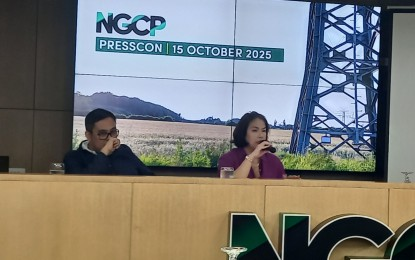

National Grid Corporation of the Philippines Assistant Vice President and Regulatory Management head Julius Ryan Datingaling (from left) and NGCP Assistant Vice President and head of public relations department Cynthia Alabanza discuss the factors for the changes in the transmission operators’ rate for the October 2025 billing during a press conference on Wednesday (Oct. 15, 2025). They said the overall power transmission rate will be lower due to a drop in the rate to P1.3998/kWh last September from the previous month’s P1.4171/kWh because of lower ancillary services rates and transmission wheeling rate. (PNA photo by Joann Villanueva)
Power transmission rates for end consumers are set to drop this October, with overall charges falling by 1.23 percent to P1.3998 per kilowatt-hour, the National Grid Corporation of the Philippines (NGCP) announced.
NGCP Assistant Vice President and Regulatory Management head Julius Ryan Datingaling said during a media briefing on Wednesday that the average transmission rate slipped from P1.4171/kWh, mainly due to reduced ancillary services (AS) costs and lower transmission wheeling rates.
Transmission wheeling rates cover NGCP’s core function of delivering electricity, while AS rates are pass-through costs tied to reserve market transactions and bilateral contracts meant to ensure grid stability.
For the September billing period, the average AS rate decreased by 1.70 percent to P0.6546/kWh, while the transmission wheeling rate declined by 0.84 percent to P0.5920/kWh.
This downward adjustment in transmission rates contrasts with Meralco’s report earlier this week, which attributed the rise in October power rates partly to higher transmission-related charges.
NGCP Assistant Vice President and Public Relations head Cynthia Alabanza clarified that the corporation does not profit from ancillary service fees. “The only reason we translate it into a month-on-month basis is so consumers can understand the charges,” she said. “But in reality, we’re revenue-capped.”